I'm slowing down
Time was when I would crush any response-time metric you put in front of me.
As soon as that email hit my inbox, BOOM! Stop what I’m doing and answer it. Send me a chat message? I’d respond as if you were standing over my shoulder. Incoming support ticket? I’d be on that thing like a third baseman on a weakly hit grounder up the line. Need a PowerPoint? Don’t measure that time in days; measure that time in hours.
From my earliest years, the metric on which I was most focused was “time from assignment to completion.” Mrs. Schultz would hand out a worksheet, and 7-year-old me would get my pencil ready and blast through that thing. Then I’d walk, with haughty 7-year-old urgency, head held high, to turn it in FIRST. This resulted in Mrs. Schultz writing, “WORKS TOO FAST” above the -2 or -3 score I’d get on the worksheet.
Gallons of red ink were expended between 1973 and 1986 by my teachers to write the same critique, “WORKS TOO FAST”, on B-plus work that could have been “A” work if I had just taken a breath sometime between picking up my pencil and making that walk to the turn-in basket.
But the dopamine hit I got from knowing the rest of the class saw me walk to the turn-in basket FIRST meant more to me than getting 100 percent on the worksheet. It was more important for me to be FIRST than to be right.
This, of course, led to a career in journalism.
My approach served me very, very well during those years. I once filed 500 words about a basketball game less than 10 minutes after the final buzzer, including the time it took for that data to make it up a 1988 phone line. As a page designer, I took it as my professional mandate that those trucks would get the newspapers in the reader’s hands on time. My stuff always made deadline. A correction a few days after the fact? Sucks, but dammit, I made deadline.
I took that sense of urgency into my tech career, and it continued to serve me well. Customers would send glowing messages to my bosses about how quickly I responded to their issues. (Dopamine hit!) Co-workers trusted me enough to get things done that they were willing to overlook some of the lack of precision in my work. (“No worries, we’ll come back to that.” Sometimes we actually did.) I could do the same work 80 percent as well as the next person but 20 percent faster. In a world where urgency meant more than precision, that mattered.
Thankfully for me, that was my world for a long time, because otherwise I’d have struggled mightily with life. My impatience is part of why I believe I am not mechanically inclined. If Tab A doesn’t slide right into Slot B on the first attempt, I’ll either get frustrated or give up. (Or both.) I absolutely hate any project where I have to, like, wait a day to let something dry before going on to the next step. I will most assuredly never plant a garden. If I can’t pick up the pencil and go to the turn-in basket in one smooth motion like I did in Mrs. Schultz’s class 50 years ago, I will throw at least an internal 7-year-old style temper tantrum. (And anybody who’s ever watched me work on anything with my hands has probably seen at least one example of said temper tantrum being external.)
Something changed. That something roughly coincided with me moving into my 50s. I trace it back to the early days of the pandemic, when we were living in the midst of a 9/11-style emergency for weeks and months. We had to digest so much input and deal with so many things being weird and then we had to absorb the realization that our government’s leadership was in over its head and that we were well and truly on our own.
As 2020 unfolded, your e-mail became a lot less important to me. I would let a chat message sit for minutes or hours. Sometimes it was because I was in the midst of another task and I would make the conscious choice to focus on that task. Sometimes, it was just because … well, it was just because.
I know now that I was tired. I know that those weeks and months of constant cortisol had simply worn me down.
I also noticed, though, that the world didn’t stop because I answered that email in a day rather than an hour. My response times slowed, but nobody seemed to notice.
All the same, I spent a lot of time beating myself up for having lost my sense of urgency. This resulted in a spiral of worrying that the world was passing me by because I was walking at the same pace as the rest of the world.
I understand now that I don’t have the same energy that I brought to Mrs. Schultz’s class in 1975. I’m starting to become OK with that. I’ve stopped typing “apologies for the slow response” (although I do occasionally thank the sender for their patience.) I fixed a broken lawnmower (hard and time-consuming and frustrating) instead of buying a new one (easy). I still get things done, but I’m now completely OK with taking a second or third or fifth look to make sure everything is as it should be.
And yeah, I still get a dopamine hit when an email reads, “Thank you for your quick response,” and it’s even better when “quick response” was the other person’s definition of “quick” rather than mine.
I’m getting older. I’m slowing down. And it’s OK.
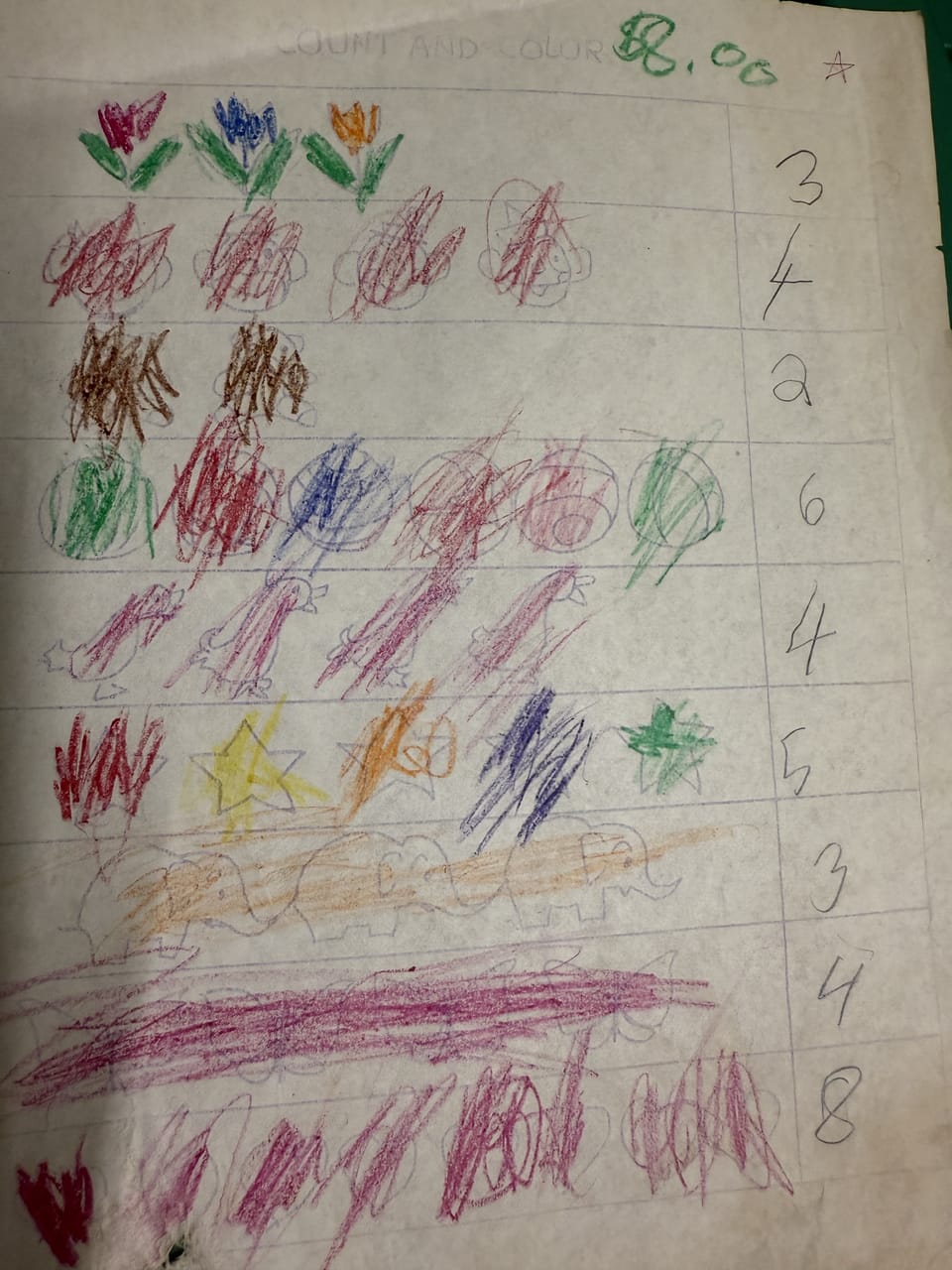
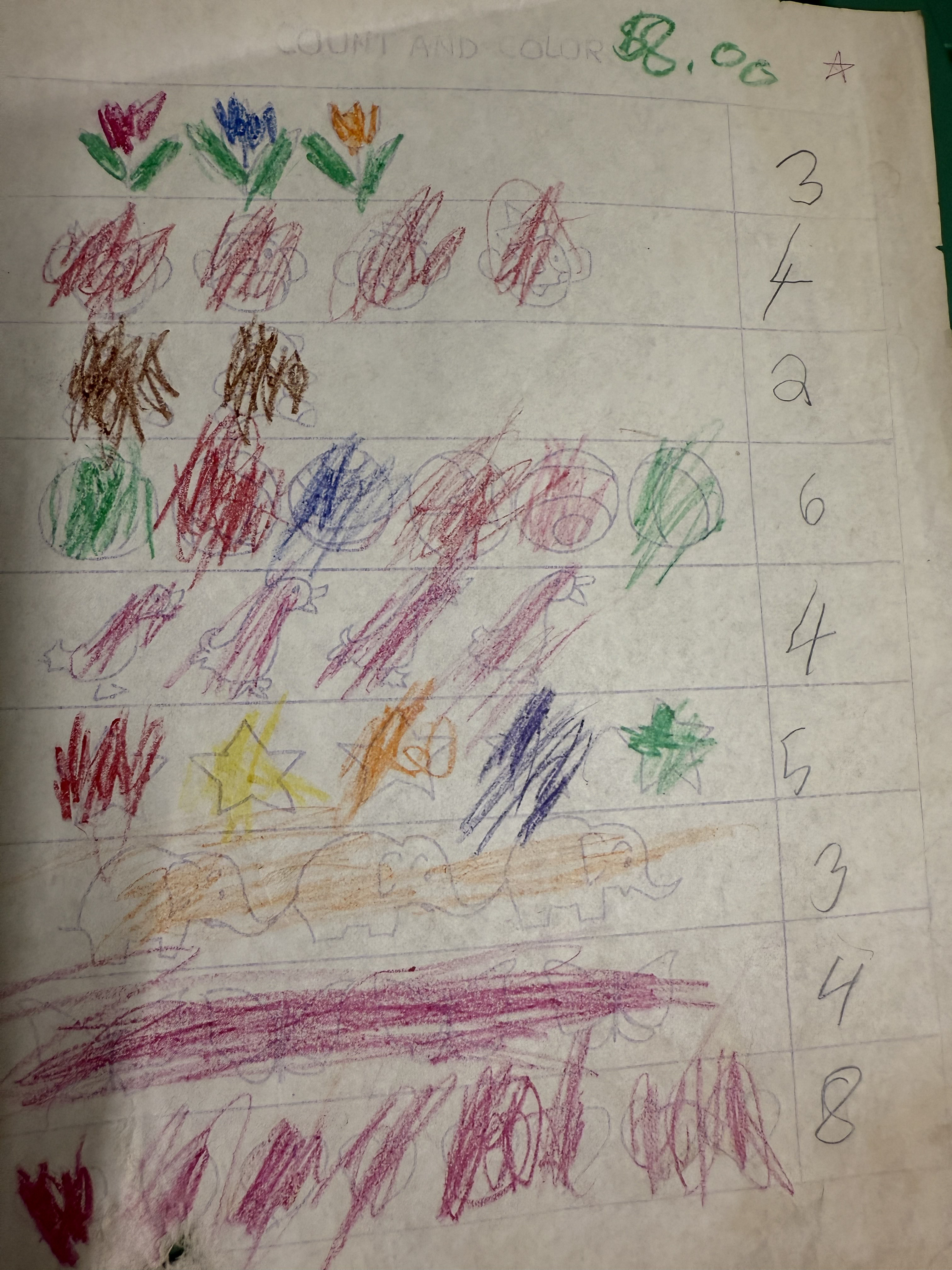
Coda: I do still struggle with my need for speed, and I’m doing so even as I type this. I’m writing this in a coffee shop. I want to post it NOOOOOOOOWWWWWWW. I don’t want to wait to get home and search one of my junk bins for the perfect illustration — one of my old worksheets with “WORKS TOO FAST” written on it in red pen. I KNOW that having an illustration will make this post more attractive to the reader. But, hey, watch me! I’m going to actually WAIT and find that worksheet that I know is around there … somewhere.
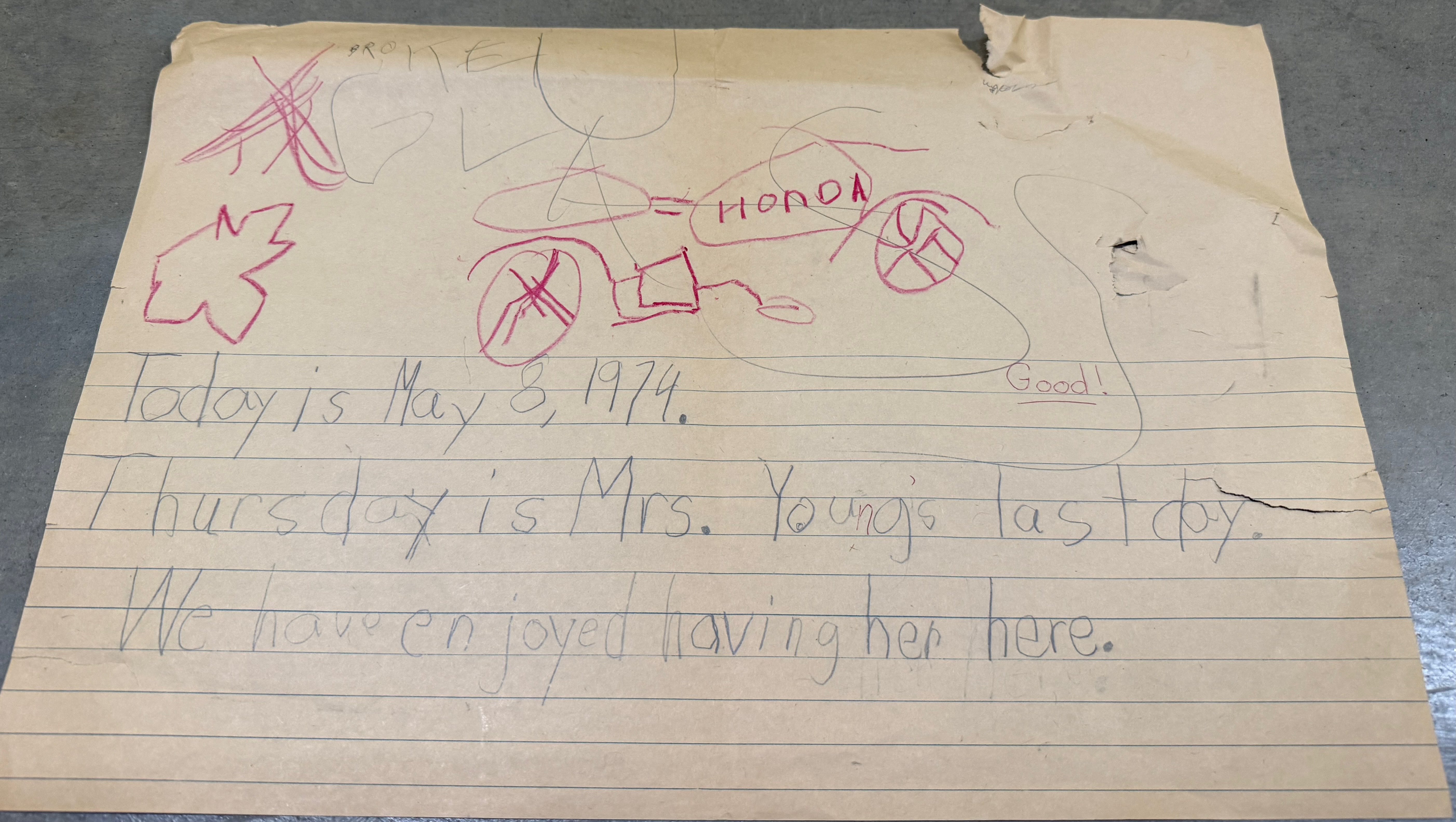
Coda 2: I ended up having to go to our storage unit, but I finally found a stash of my old schoolwork, from kindergarten. Unfortunately, I couldn’t find anything labeled “WORKS TOO FAST,” although I know said work likely exists somewhere, probably at my mother’s house. So instead, I’ll show you a masterpiece from kindergarten. I think the artwork is supposed to be a motorcycle, as seen through the broken windshield of a car, which I very clearly labeled BROKE GLASS by way of explanation. Mrs. Young was the student teacher in that class. Crazy to think that wherever Mrs. Young is now, she’s well into her 70s.
Coda 3: For those of you who read this post in email, I left the typo in the third-to-last paragraph in there ON PURPOSE to make a point. (Convincing, no?)