Music was always allowed
“That’s not a toy.”
My mother’s voice, hissing at 4-year-old me through clenched teeth, as I tried to climb up on a chair to turn the hands of the cuckoo clock on the wall of my grandparents’ house. I wanted to see the cuckoo bird pop out of the little door, and I was tired of waiting for the top of the hour. She lifted me up, plopped me down, and let forth an exasperated exhale as she pushed the chair back under the table.
“Put that down; that’s not a toy.”
My grandmother’s voice, layer upon layer of weary love, having raised eight kids of her own, exhorting 4-year-old me to not walk away with that glass bowl that held all the Brach’s candy. I’d put the bowl down, she’d look to make sure my mama wasn’t looking, then she’d take off the top and let me pick a piece.
“Don’t turn that knob; that ain’t a toy.”
My grandfather’s west Texas drawl, thickened with Sir Walter Raleigh tobacco from a pipe, emerging from the hallway after I disappeared around the corner into the room where his CB-radio rig was set up. He had it dialed in just so, not just to talk to people around town but to be able to “skip” the signal well past the FCC limits to talk to people around the country. He and his CB good buddies exchanged postcards when they made contact. It was kind of a 1970s version of a social network.
My childhood was one thwarted attempt after another to investigate things I wasn’t supposed to touch. That’s breakable, that’s electric, that’s not a toy. My grandparents’ little house was full of tchotchkes and gadgets and things that were well and truly off-limits to little hands like mine.
That little house also was full of something else: Musical instruments.
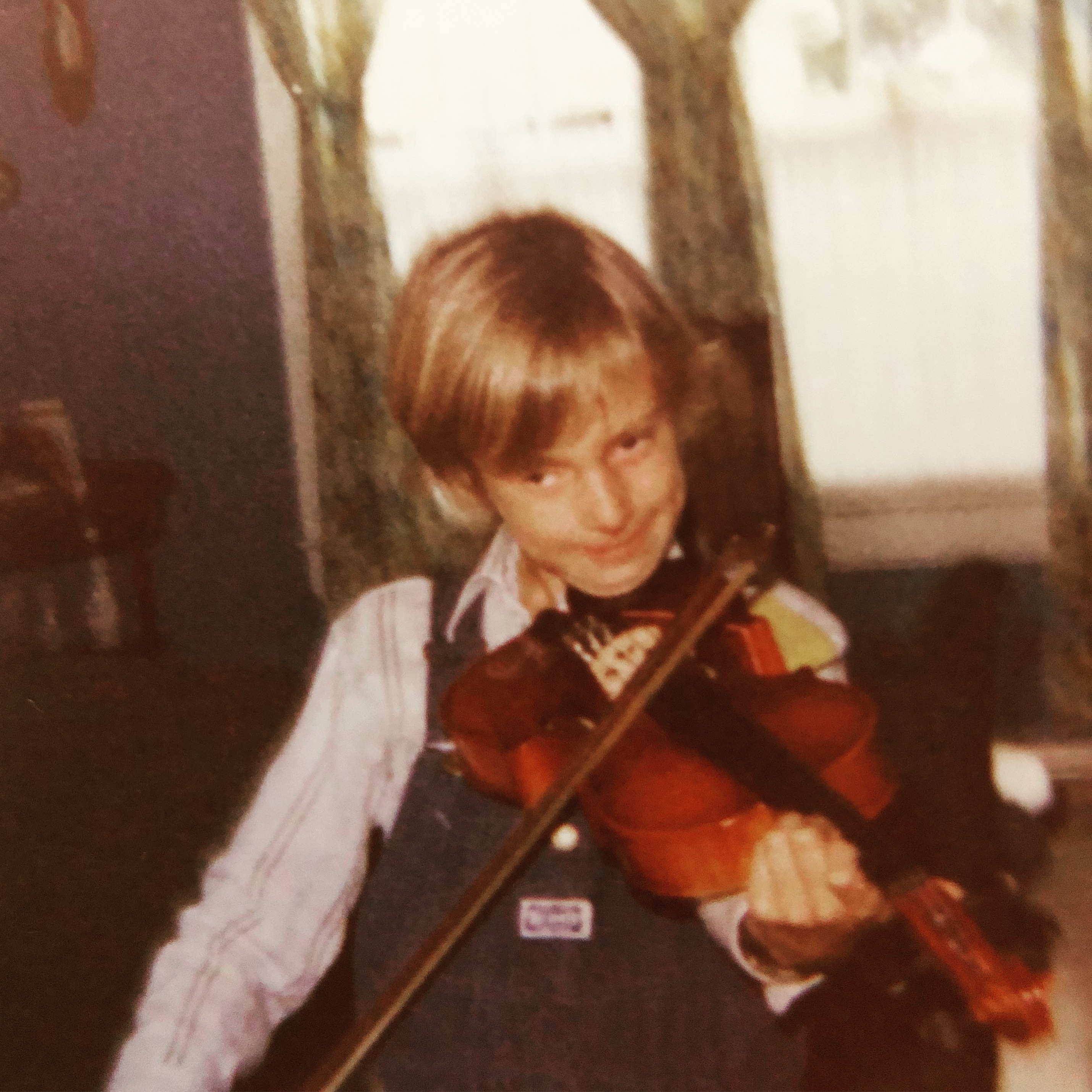
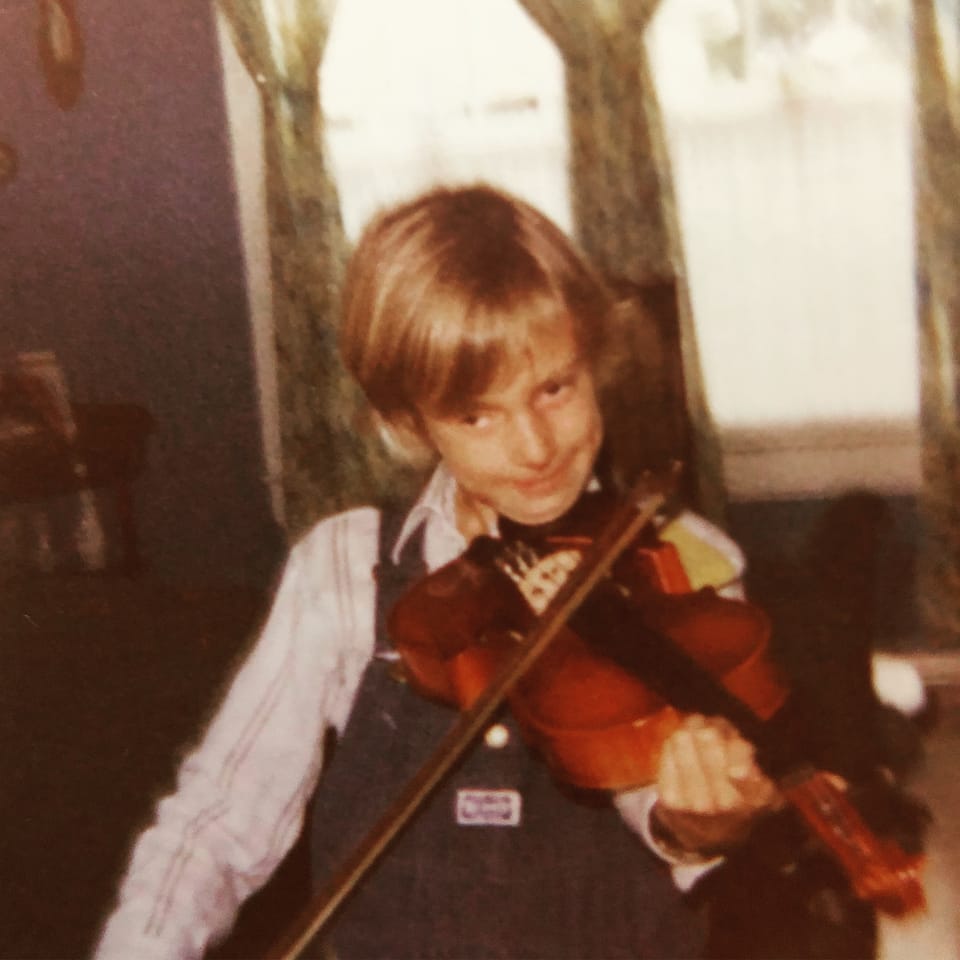
(Me, age 10 or 11, with my viola. I have no good answer for the overalls.)
A piano in the back room. An off-brand guitar, old strings sitting way high off the neck, but always in tune. My uncle’s new electric guitar, purchased from the Sears catalog, bright red with coiled cord plugged into an amplifier as tall as me, with sparkly cloth covering the speakers. Occasionally a banjo or a mandolin brought over by one of my great-uncles, who played in a bluegrass band. Harmonicas. Tambourines.
I’d see that old acoustic guitar laying on the couch. I’d sit down quietly next to it, and I’d put it in my lap the way my dad and my uncles held their guitars. I’d put my little left hand around the neck and put a finger down on a string with all my strength, and reach over the top with my little right hand and pluck that string. I’d move my finger up the neck and pluck again, marveling at how the tone changed. Up and down, pluck, pluck, pluck, always a new sound. I’d put two or three of my fingers down on that neck, forming a random non-chord, and I’d start singing, trying to imitate my dad and my uncles at family gatherings. “I saw the light, I saw the light … No more darkness, no more night. Now I’m so HAP-PY, no sorrow in sight! Praise the Lord, I saw the liiiiiiiiiight.”
“Now, that’s not a toy,” my uncle Connie would say, gently. “Be careful with it.” And then he’d move my little finger between the second and third frets on the bottom string. He’d help me stretch my middle finger between the second and third frets of the top string. He’d put my index finger between the first and second frets of the second string. “Now, hit all the strings,” he’d say, and I’d strum with my right hand, and more or less, the sound of a G chord would emerge. I’d strum and strum that chord and just repeat “I saw the light, I saw the light,” and I was no longer Little Ronnie the shy, nerdy first-grader; I was playing a song just like the grownups did.
When the adult conversation got boring or the secondhand smoke got too stifling, I’d shuffle away to that back room to sit at that upright piano. I’d just hit keys for hours, no real melody, a small hint of a rhythm, just making noise. Aunt Judy would wander by occasionally and show me where middle-C was, “right here by where it says ‘KIMBALL’ on the lid,” and help me to play a scale. Do-re-mi-fa-so-la-ti-do, up and down, over and over.
When Great-Uncle Jackie’s banjo was laying on the couch, I’d pick it up and pluck the strings just to hear if it sounded the same as it did when Roy Clark played. When the harmonica was on the end table, I’d pick it up and blow in it. I’d spy that tambourine on my grandpa’s chair, left behind by one of my aunts after a family singalong, and I’d pick it up and walk around the house and shake it, holding it as high over my head as my little arms would allow. All of us cousins would pass the instruments around and shake them and pluck them and make as much noise as we could. I was among the oldest, so I’d never miss an opportunity to tell one of the younger ones, “Be careful; that’s not a toy.”
Look with your eyes, not with your hands: The TV remote, the buttons on the air conditioner, and Grandpa’s golf clubs, those were not to be touched. The musical instruments, however, were all fair game, no matter how delicate, how loud, or how much we didn’t know how to play them.
I learned quickly, even as a little boy: In my family’s home, music was never reprimanded. Music was never punished. Music was never wrong.
One day, I found the Mel Bay Guitar Method book, tucked among the Family Circles and the TV Guide in the magazine rack by Grandpa’s chair, and that was how I finally learned the difference between a G and a G7 and added C and D and E-minor to my repertoire. I found my dad’s John Denver Songbook when I was 10 or so and deciphered “Country Roads,” the first song I learned all the way through. My Uncle Lonnie taught me when I was 11 that I could make almost an entire song by lifting or adding the second and fourth fingers on a D chord.
At age 20, the first thing I bought with my first paycheck from my first full-time job was a guitar. I bought a black Telecaster, because Waylon Jennings and Merle Haggard and Marty Stuart played Telecasters. I spent that entire check on it, but that was OK. Nobody acted surprised or even questioned it. Music was never wrong.
Last year, I gave that Telecaster to my middle son. He plays it way better than I ever did. He’s almost 23, and he’s known that guitar literally all his life. He has heard me tell him, “that’s not a toy.” But he never heard me tell him to put it down.